The best product feedback software in 2026
Last updated 18th May 2026
Product feedback software gives your users a structured way to submit ideas, vote on feature requests, and track what you are building — and gives your team the data to make confident prioritisation decisions. Without it, product decisions tend to be driven by whoever speaks loudest: the enterprise customer on the phone, the last support ticket you read, or whoever had the most recent conversation with your CEO. Good feedback software replaces that noise with signal.
This guide covers seven tools across the product feedback category — from lightweight voting boards to full research platforms — so you can find the right fit for your team's size, workflow, and budget.
At a glance comparison
| Feature | Noora | Canny | Featurebase | ProductBoard | Dovetail | Hotjar | UserVoice |
|---|---|---|---|---|---|---|---|
| Feature voting Let users vote on feature requests and ideas. | ✅ | ✅ | ✅ | ✅ | ❌ | ❌ | ✅ |
| Public roadmap Show customers what you are planning to build. | ✅ | ✅ | ✅ | ✅ | ❌ | ❌ | ✅ |
| Changelog Publish release notes and product announcements. | ✅ | ✅ | ✅ | ❌ | ❌ | ❌ | ❌ |
| NPS surveys Measure customer satisfaction with in-app surveys. | ✅ | ❌ | ✅ | ❌ | ❌ | ✅ | ✅ |
| Anonymous feedback Collect feedback without requiring user accounts. | ✅ | ❌ | ✅ | ❌ | ❌ | ✅ | ❌ |
| Free tier Get started without a credit card. | ❌ | ✅ | ✅ | ✅ | ✅ | ✅ | ❌ |
| Starting price Lowest paid plan, monthly billing. | $29/mo | $19/mo | Free | $19/maker/mo | Free | Free | ~$1,333/mo |
Detailed look at each tool
1. Noora
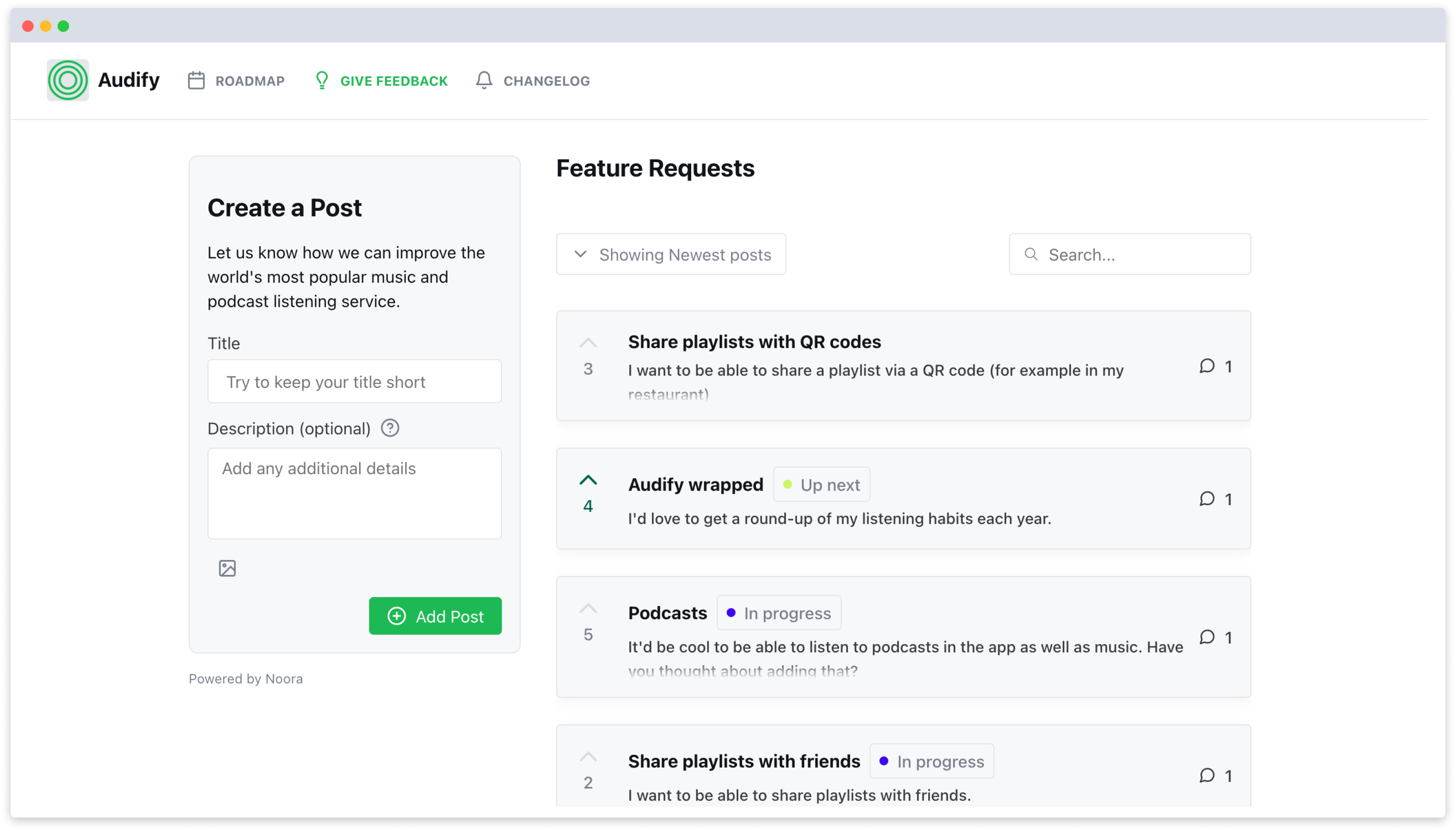
Noora is an all-in-one product feedback platform built specifically for SaaS teams. It combines feature voting, a public roadmap, a changelog, and NPS surveys in a single tool. The key advantage over most alternatives is that all four components are connected: when you ship a feature that users requested, Noora automatically notifies everyone who voted for it — closing the feedback loop without any manual work from your team. Noora also supports anonymous feedback on all plans, which removes the sign-up friction that causes many users to abandon feedback portals before submitting.
Noora benefits
- Feature voting, public roadmap, changelog, and NPS surveys in one subscription — no add-ons required.
- Anonymous feedback on all plans, so you capture votes from users who have not created an account in your portal.
- Automatic email notifications when a feature ships — every voter is notified the moment you mark a request as Shipped.
- User segmentation on Growth and above — filter feedback by MRR, subscription plan, or any custom attribute you pass via the API, Intercom, or Segment.
- NPS surveys with follow-up questions, so you understand the reasons behind each score rather than just the number.
- SEO support — your portal and changelog are indexed by search engines, with an auto-generated sitemap when you connect a custom domain.
- Integrations with Slack, Intercom, Zapier, and Segment on paid plans.
Noora pricing
The Startup plan starts at $29/month ($14/month billed annually) and includes feedback boards, public roadmap, changelog, and NPS surveys. The Growth plan is $59/month ($29/month annually) and adds user segmentation, private boards, custom domain, and Segment. Enterprise is $129/month ($64/month annually) and includes custom CSS and white-labeling.
Start your free 7-day trial today
2. Canny
Canny is one of the most established names in the product feedback category. It covers the core workflow — collecting feature requests, organising them by board, assigning statuses, and publishing a public roadmap and changelog — and has continued to improve its product over several years. The most significant addition in recent years is Autopilot: an AI layer that automatically captures feedback from customer conversations in tools like Intercom and Zendesk, deduplicates similar requests, and generates smart replies. Autopilot is included on every Canny plan, including the free tier, which makes it unusually accessible compared with AI features at other tools. Canny's integration ecosystem is broad, and with over 50,000 companies using the platform, it is a proven choice for teams of most sizes.
Canny benefits
- AI Autopilot on all plans including free — automatically discovers and deduplicates feedback from customer conversations, generates smart replies, and summarises comment threads.
- A generous free plan for small teams (up to 25 tracked users).
- Paid plans start at $19/month — competitive pricing for the feature set on offer.
- Mature integrations with Intercom, Zendesk, Salesforce, Jira, GitHub, and many more.
- Changelog and public roadmap included on paid plans.
Canny pricing
Canny offers a free plan for up to 25 tracked users. The Core plan is $19/month and the Pro plan is $79/month. Business pricing is custom. Pricing scales with tracked users — anyone who posts, votes, or comments counts toward your quota, so costs can increase as your active user base grows.
Visit Canny's website at canny.io
3. Featurebase
Featurebase is a modern, all-in-one feedback platform that has gained traction quickly among AI-native and developer-focused SaaS companies. It covers feature voting, public roadmap, changelog, NPS surveys, and in-app widgets in one tool, with a clean interface that requires minimal configuration. Featurebase has a genuinely generous free tier — not just a limited trial — which makes it one of the easiest tools to evaluate properly before committing to a paid plan. It also supports anonymous feedback on free and paid plans, which is not a given in this category.
Featurebase benefits
- Generous free tier with no time limit — suitable for early-stage teams that need core feedback functionality without a subscription.
- All-in-one: feature voting, roadmap, changelog, NPS surveys, and in-app widget included.
- Anonymous feedback supported on all plans.
- Modern, clean interface favoured by developer-tool and AI-native companies.
- In-app widget for embedding your feedback board and changelog directly inside your product.
- Integrations with Jira, Linear, GitHub, Slack, Intercom, and Zapier.
Featurebase pricing
Featurebase has a free plan with core features included. The Starter plan is $49/month and the Growth plan is $99/month, adding advanced integrations, custom domains, and priority support. Enterprise pricing is custom. All plans include the feedback board, roadmap, and changelog.
Visit Featurebase's website at featurebase.app
4. ProductBoard
ProductBoard sits closer to a full product management platform than a standalone feedback board. Beyond collecting and voting on requests, it supports a detailed product hierarchy — features, epics, and objectives — plus custom prioritisation scoring and deep integrations with engineering tools like Jira and Azure DevOps. This makes it particularly useful for larger product teams that need to align roadmap planning with OKRs or business objectives, not just raw vote counts. ProductBoard is used by enterprise companies including Zoom, Autodesk, Salesforce, and Coca-Cola. The tradeoff is complexity: it takes longer to set up and requires more ongoing configuration than simpler tools in this list.
ProductBoard benefits
- Free Starter plan for teams beginning to formalise their feedback process.
- Product hierarchy — create features, epics, and objectives so your roadmap reflects the actual structure of your product.
- Custom prioritisation scores — rank requests by business impact, effort, and strategic fit, not just vote counts.
- Robust integrations with Jira, Azure DevOps, Salesforce, and Zendesk.
- Used by 6,000+ product teams including Autodesk, Zoom, and Salesforce.
- Spark AI (beta) — an AI-native companion for drafting product specs, analysing feedback themes, and generating acceptance criteria.
ProductBoard pricing
ProductBoard plans start at $19/maker/month (Essentials, billed annually) and $59/maker/month (Pro, billed annually). There is also a free Starter tier with limited usage. Enterprise pricing is custom. Note that pricing is per internal "maker" (team member), not per customer contact — costs scale with team size and can become significant for larger organisations.
Visit ProductBoard's website at productboard.com
5. Dovetail
Dovetail is a qualitative research and customer insights platform — a different category from the voting and roadmap tools above, but one that product teams frequently consider alongside them. Rather than collecting structured feature requests, Dovetail is designed to help you analyse unstructured feedback at scale: interview transcripts, support tickets, app store reviews, survey responses, and sales call recordings. It uses AI to automatically tag themes, surface patterns, and generate summaries across large volumes of qualitative data. If your team conducts regular user research and struggles to synthesise findings from dozens of interviews, Dovetail solves a problem that voting boards cannot. It is not a substitute for structured feedback collection, but it complements it well for research-heavy teams.
Dovetail benefits
- AI-powered analysis of qualitative data — automatically tags and summarises themes across interview transcripts, support tickets, and other unstructured sources.
- Centralised research repository — store all your customer research in one searchable, shareable place.
- Supports a wide range of data sources: video/audio recordings, documents, survey responses, and integrations with Zoom, Slack, and Intercom.
- Free plan available — suitable for individuals and small teams starting out with user research.
- Used by research teams at Atlassian, Canva, and Intercom.
Dovetail pricing
Dovetail has a free plan for individuals. The Team plan is $29/user/month (billed annually) and includes AI analysis, unlimited projects, and collaboration features. Enterprise pricing is custom. Note that Dovetail does not include feature voting, a public roadmap, or a changelog — it is a research and insights tool, not a feedback board.
Visit Dovetail's website at dovetail.com
6. Hotjar
Hotjar is primarily a behavioural analytics tool — best known for heatmaps, session recordings, and conversion funnels — but it is commonly evaluated alongside feedback tools because it also includes in-app feedback widgets and NPS surveys. The feedback widget lets you embed a small button in your product that opens a simple form where users can rate their experience and leave a comment. This passive, always-on collection method captures feedback in context, at the moment users encounter friction, without requiring a dedicated portal. Hotjar does not include feature voting, a public roadmap, or a changelog, so it works best as a complement to a structured feedback tool rather than a replacement for one.
Hotjar benefits
- Heatmaps and session recordings reveal exactly where users are clicking, scrolling, and dropping off — contextual insight that voting boards cannot provide.
- In-app feedback widget for always-on, contextual feedback collection directly inside your product.
- NPS and CSAT surveys included on paid plans.
- Generous free tier — heatmaps, recordings, and basic feedback collection are available without a subscription.
- Easy to install with a single script tag; no engineering effort required for the basic setup.
Hotjar pricing
Hotjar has a free plan that includes heatmaps, session recordings, and limited feedback features. Paid plans start at $32/month (Plus) and $80/month (Business), with pricing scaling based on daily sessions tracked. The feedback and survey features are available on all paid tiers. Enterprise pricing is custom.
Visit Hotjar's website at hotjar.com
7. UserVoice
UserVoice is built for large enterprise organisations running structured, high-volume feedback programs. It is one of the longest-standing tools in this category and remains the choice for companies where feedback flows in from thousands of customers across multiple channels and requires dedicated program management to handle. Microsoft uses UserVoice to collect feedback for products including Teams and Excel. If you are a startup or growth-stage SaaS company, UserVoice will be both too expensive and too complex for your needs — but for enterprise teams with a dedicated product operations function, it provides compliance, security, and scalability that simpler tools cannot match.
UserVoice benefits
- Purpose-built for enterprise-scale feedback programs with compliance, security, and audit features to match.
- Volume-based pricing model — you are not charged per seat, which works well for large internal teams.
- Dedicated customer success manager and a structured onboarding program.
- NPS surveys and admin analytics dashboards included.
- Used by Microsoft, which uses UserVoice portals to collect feedback for Teams, Excel, and other products.
UserVoice pricing
UserVoice pricing starts at approximately $16,000/year (~$1,333/month), billed annually. There is no self-serve sign-up — all plans require a sales call. This puts UserVoice squarely in the enterprise tier, alongside tools like Salesforce and Qualtrics, and well outside the budget of most early- and mid-stage SaaS teams.
Visit UserVoice's website at uservoice.com
Frequently asked questions
What is product feedback software?
Product feedback software is a category of tools that helps product teams collect, organise, and act on feedback from their users. It typically includes a public portal where users can submit feature requests, vote on existing ideas, and track the status of their requests through a roadmap. The best tools also include a changelog for communicating when requests have shipped, and survey features like NPS for measuring overall satisfaction. The goal is to replace ad-hoc, scattered feedback — from emails, support tickets, and Slack messages — with a structured system that makes it possible to make prioritisation decisions based on real user data.
What is the difference between product feedback software and customer survey tools?
Customer survey tools — like Typeform, SurveyMonkey, or Google Forms — are designed for one-time or periodic data collection. You send a survey, users respond, and you analyse the results. They are useful for structured research but do not provide a persistent, always-on channel for users to submit ideas or track what you are building. Product feedback software, by contrast, is a living system: users can submit ideas at any time, vote on others' requests, follow the status of their submissions, and get notified when something ships. The two categories serve different purposes and work well together — survey tools for specific research questions, feedback software for continuous input on product direction.
How do I get more users to submit feedback?
The single biggest lever is reducing friction at the point of submission. Tools that require users to create a separate account before submitting typically see far lower participation rates than tools that allow anonymous or single-click submission. Beyond that, the most effective approaches are: embedding a feedback widget directly inside your product so users can submit in context without navigating away; sending a targeted email or in-app message to active users asking for their input on a specific topic; and closing the loop publicly — when users see that their previous feedback led to a shipped feature, they are far more likely to contribute again. Displaying vote counts also encourages participation, as users can see their vote will influence something, not disappear into a void.
Which product feedback tool is best for a small SaaS team?
For most small SaaS teams, the decision comes down to budget and which features matter most. If you want a free starting point, Featurebase and Canny both offer free tiers with meaningful functionality. If you want an all-in-one tool that covers feedback, roadmap, changelog, and NPS without add-ons, and are happy to pay from day one, Noora at $29/month is the strongest option — it gives you user segmentation, anonymous feedback, and automatic voter notifications at a price point where other tools require higher-tier plans. Avoid UserVoice and ProductBoard at the enterprise tier unless your team is large enough to justify the cost and complexity.