3 Best Ways To Collect Game Feedback
Last updated 16th May 2026
Your most dedicated players know what they love and hate about your game better than anyone. Listening to them is one of the most reliable ways to improve your core mechanics, identify bugs before they go viral on social media, and build the kind of passionate community that drives long-term word of mouth. This article covers the three most effective approaches for game studios collecting feedback, and how to combine them.
Getting your feedback strategy right also sets the foundation for building a strong community around your title — one that generates organic buzz as you launch new content, expansions, and sequels.
1. A dedicated feedback portal with voting
A dedicated feedback portal gives your players a structured place to submit bug reports, feature requests, and gameplay suggestions — and to vote on what others have already submitted. The voting mechanism is what makes this approach particularly powerful for game studios: instead of every player posting the same bug report independently, a single popular issue accumulates votes and surfaces immediately as a priority.
For example, Invisible Walls used Noora to collect and organize feedback for their Steam title First Class Trouble. You can read more about their journey here.
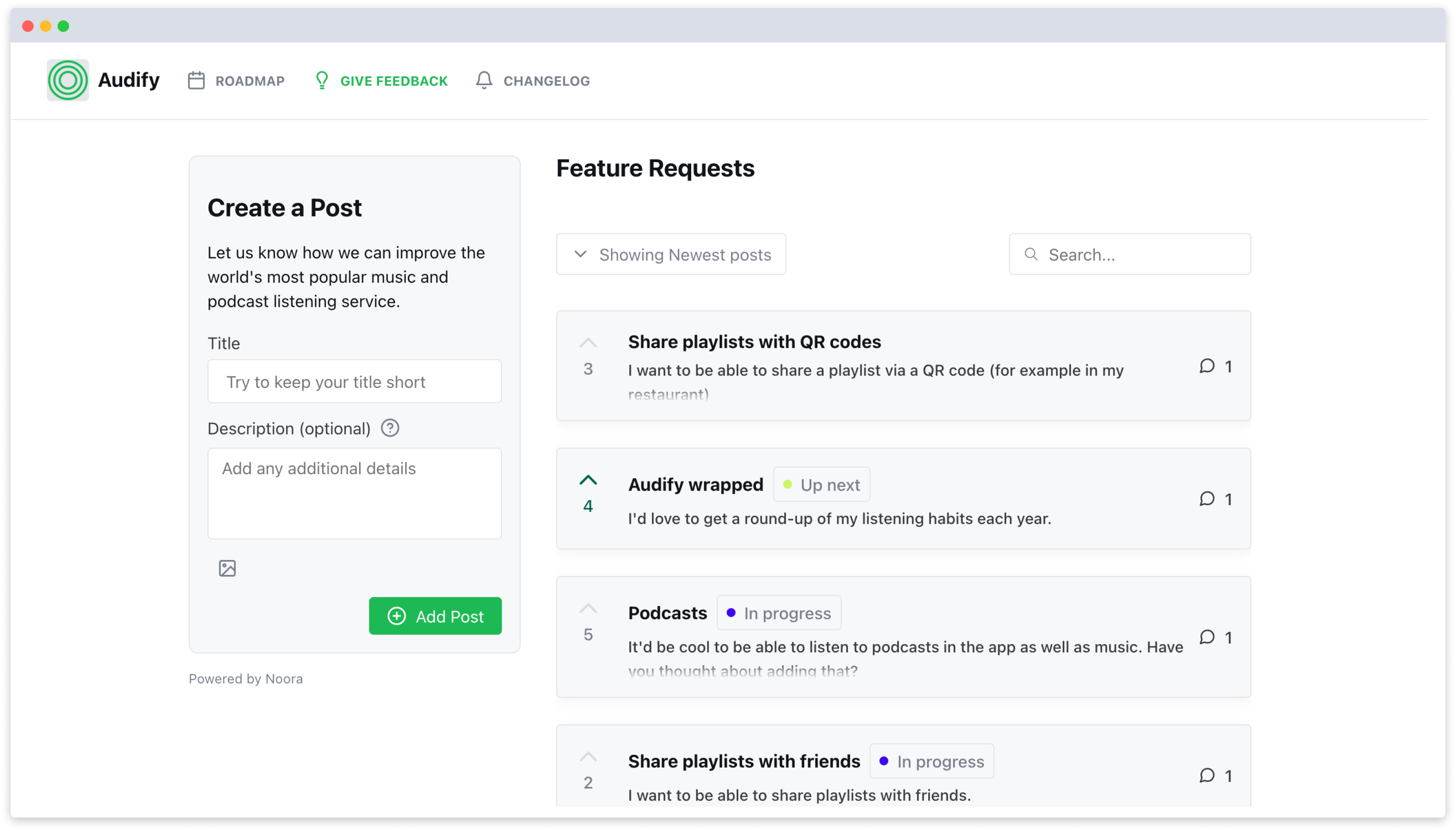
Noora supports multiple feedback boards within a single portal — useful for separating bug reports from feature requests, or for managing feedback across different game modes or platforms. Each board can have a custom form with required fields, so your QA team gets structured, reproducible bug reports rather than vague "the game crashed" messages.
You can also share your public roadmap — particularly valuable for Early Access titles on Steam, where players who bought in early want a clear picture of what content is coming and when. Noora automatically notifies players who voted on a request when you update its status, creating a genuine sense of shared ownership over the game's direction.
Noora's feedback portal starts at $29/month, with discounts available for indie studios. The product is built by a team with games industry experience, including time at SEGA.
Learn more about using Noora to collect feedback for your game.
2. Steam community forums
Steam provides community forums for your titles at no cost — a great way to start building a community around your game without any setup. For brand new studios or very early titles, Steam forums alone may be all you need.
The limitations appear as you scale. Forums become difficult to moderate and nearly impossible to organize — popular games like Minecraft have thousands of threads covering the same issues, making it hard for your team to identify patterns or respond to feedback systematically. Forums also favor vocal, frequent posters over the broader, quieter majority of your player base.
Our recommendation: use Steam's community forums as your public-facing community space for discussion, and pair them with a dedicated feedback portal for structured bug reports and feature requests. The two serve different purposes and work best together.
3. One-off surveys
Surveys are useful for collecting focused, quantitative feedback on specific topics — playtime satisfaction, willingness to pay for DLC, or opinions on a proposed gameplay change. They are particularly effective when sent to players at a natural milestone: after their first 10 hours of play, after completing the main campaign, or after a major update.
The limitations of surveys are well-documented: they are hard to get players to complete (email surveys have notoriously low response rates for games), they only capture what you thought to ask about, and they do not build community or create ongoing dialogue with your player base.
Think of surveys as a tool for specific research questions rather than a continuous feedback channel. For the always-on feedback loop — the bug reports, the balance suggestions, the "please add controller support" requests — a feedback portal and community forums do the job far better.
Which approach is right for your studio?
Most studios benefit from using all three in combination: a feedback portal as the primary structured channel, Steam forums for community discussion, and occasional surveys for targeted research. Start with the feedback portal — it is the highest-leverage investment — and layer in surveys once you have a clear research question in mind.
The studios that build the strongest communities are the ones that close the loop with their players: acknowledging feedback publicly, showing players what is being built based on their input, and notifying them when it ships. That loop is what turns casual players into advocates.