How to collect and manage customer feedback to improve your SaaS product
Last updated 16th May 2026
This article assumes you have already launched, or are about to launch, your SaaS product. There are plenty of resources for validating ideas before writing code — this is not one of them. Instead, this dives into the mechanics of gathering feedback to improve a product that real users are already using, and reaching the point where you are consistently building what they actually want.
Why customer feedback matters more than analytics alone
Tools like Mixpanel, Amplitude, and Google Analytics tell you what users are doing. They cannot tell you why users do — or do not do — something, or what they wish your product could do instead. Customer feedback fills that gap. It gives you the qualitative context that makes your quantitative data interpretable, and it often surfaces the most valuable insights before they show up in metrics at all.
At the early stages, Paul Graham's advice to "do things that don't scale" still holds: personally reach out to every user who signs up, find out what job they hired your product to do, and listen carefully to where it falls short. As you scale, structured feedback channels replace one-to-one conversations — but the goal is the same.
Direct vs. indirect feedback
Customer feedback arrives through two channels, and handling both is essential.
- Direct feedback is when a user proactively reaches out with a specific request or complaint — a bug report, a feature request, or a suggestion they cared enough to write down.
- Indirect feedback is feedback that arrives in the course of another interaction — embedded in a support conversation, mentioned on a sales call, or buried in an onboarding email. This type is often richer and more honest, but it is also the most frequently lost because no one captures it systematically.
Experience shows that indirect feedback is where most of the signal lives, and where most teams fail. A support rep reads a useful insight, helps the user, and moves on. The insight never reaches the product team. A well-designed feedback system captures both types and routes them into a single place.
Direct feedback channel #1 — A public feedback portal with voting
A public feedback portal gives your users a dedicated place to submit ideas, report issues, and vote on what others have already suggested. The voting mechanism is what makes this valuable at scale: instead of every user submitting the same request independently, a single popular request accumulates votes and surfaces clearly as a priority.
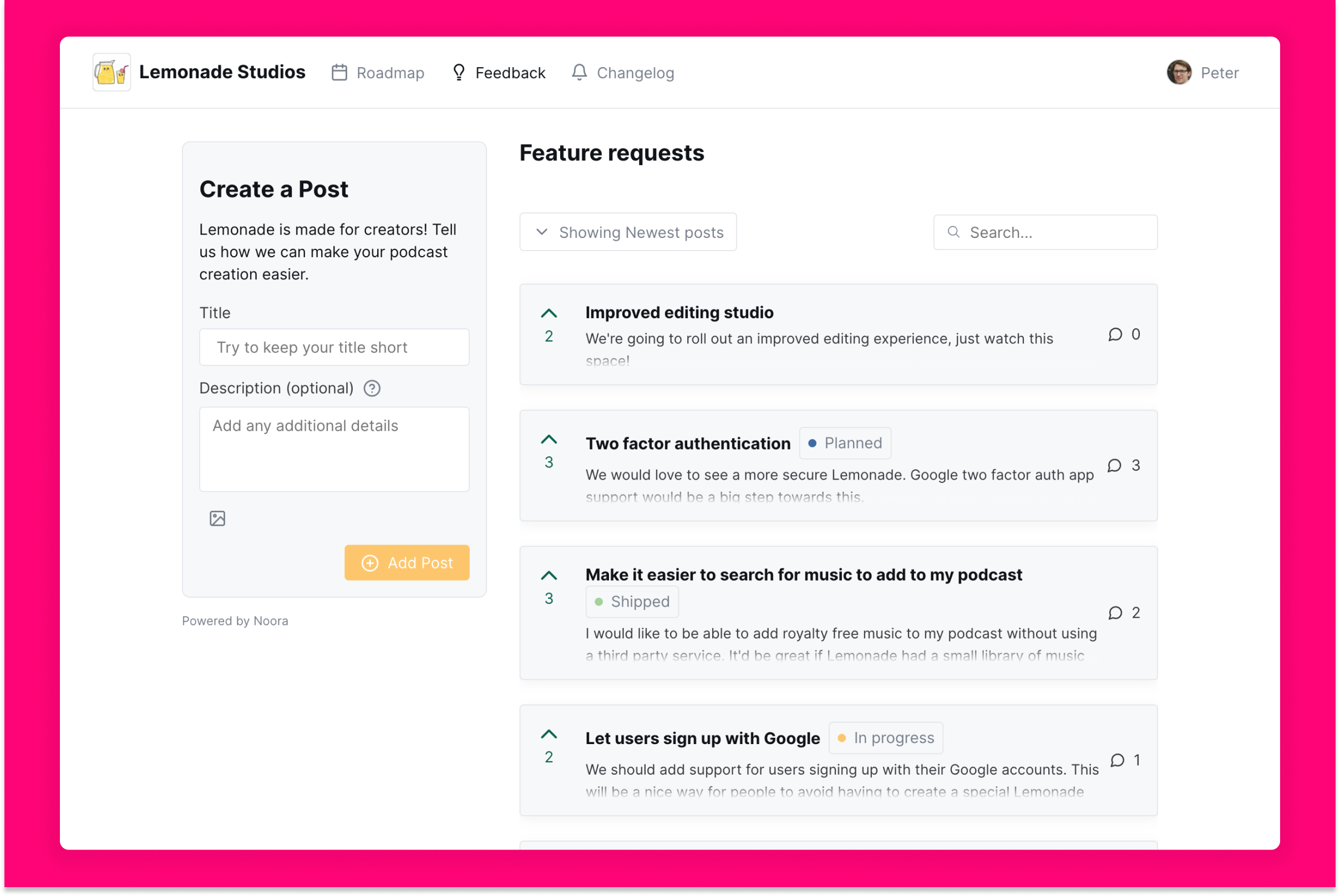
A public feedback portal built with Noora
The key requirement for a feedback portal is that it should be easy enough that your actual users fill it in — not just your power users. Tools like Noora support anonymous feedback and seamless SSO so that users do not have to create a separate account to participate. The lower the friction, the more representative the signal.
Direct feedback channel #2 — A public roadmap
A public roadmap shows users what you are working on, what is planned, and what has shipped. It serves two purposes: it reduces inbound questions about upcoming features, and it gives users who have submitted feedback the confidence that their input is being considered.
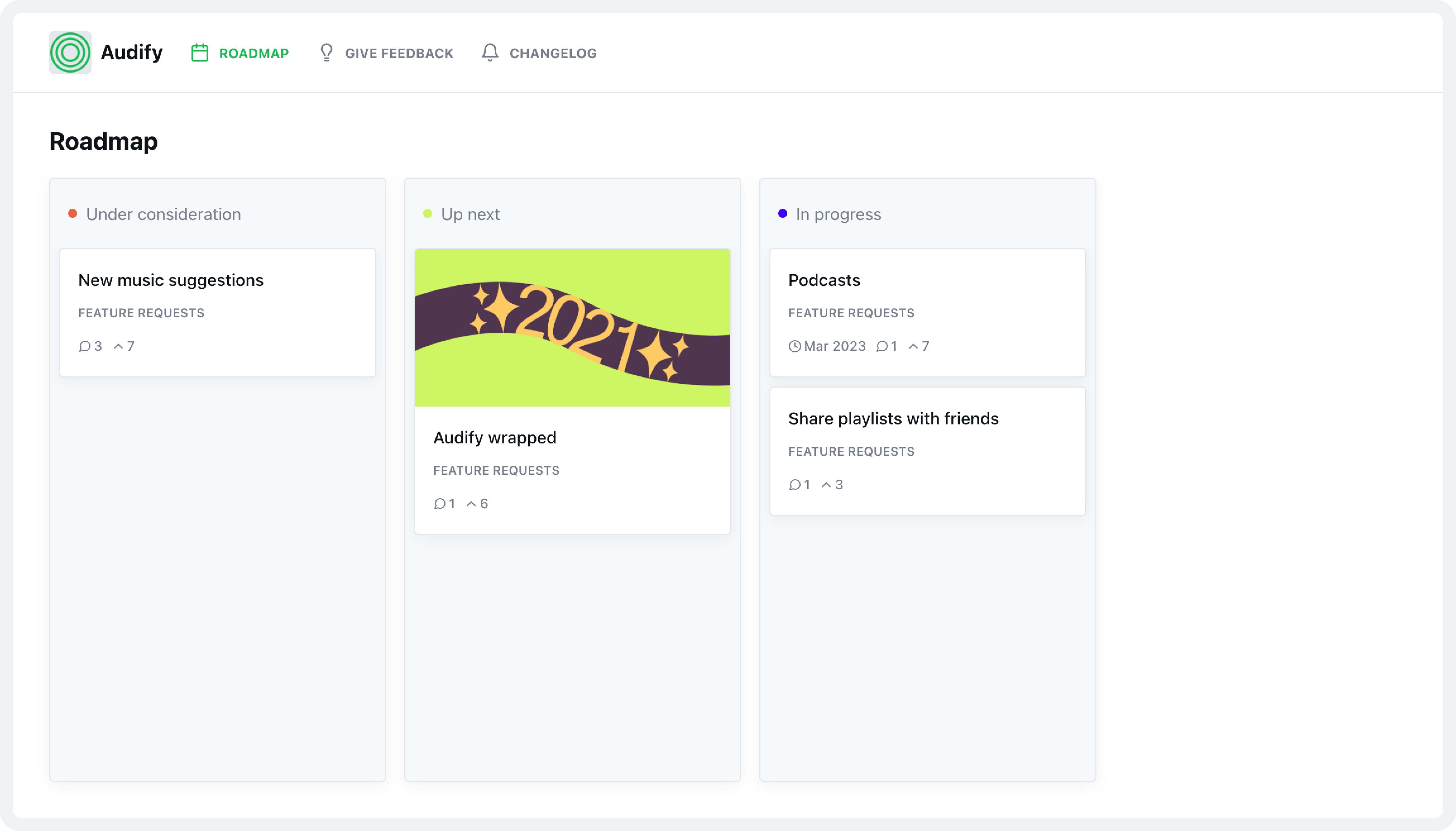
Sharing your public roadmap with Noora
The best roadmap tools — like Noora — automatically promote feature requests to your roadmap as you move them through your workflow. When a request is marked as In Progress or Shipped, every user who voted for it receives an automatic email notification. This closes the feedback loop without any manual effort and builds real loyalty: users feel they had a hand in shaping the product.
Direct feedback channel #3 — Surveys
Periodic surveys are useful for collecting structured feedback on specific questions. Net Promoter Score (NPS) surveys measure overall satisfaction and surface detractors before they churn. Product-Market Fit surveys help you understand whether users would be very disappointed if your product disappeared — a leading indicator of retention.
The key to survey response rates is delivery context: in-app or on-site surveys consistently outperform email surveys because they catch users while they are actively engaged with your product. Keep surveys short — two to three questions maximum — and always include at least one open-ended question so users can tell you things you did not think to ask about.
Indirect feedback — capturing insights from conversations
The most valuable feedback often arrives indirectly: in a support ticket, on a sales call, in an onboarding conversation, or in a Slack DM. The challenge is that this feedback is scattered across tools and people, and rarely makes it to the product team in any organized form.
A dedicated insights workflow solves this. Noora's Chrome browser extension lets your team highlight any text from an email, Intercom conversation, or support ticket and save it as an insight in seconds — linked to the specific user who said it. As insights accumulate, you can tag them to existing feature requests, spot patterns across users, and see which requests are backed by the most qualitative signal from your most valuable customers.
This is the difference between building based on whoever happens to shout loudest and building based on a clear picture of what your users actually need.
What about AI-powered feedback tools?
A newer category of tools — including Kraftful, Dovetail, and Zeda.io — has emerged that uses AI to analyze feedback at scale. These tools pull in unstructured feedback from support tickets, app store reviews, call transcripts, and more, then use AI to cluster themes, surface trends, and generate summaries without requiring manual tagging.
For teams processing hundreds of thousands of pieces of feedback across many channels, AI-native tools can be transformative. For most early and growth-stage SaaS companies, the more practical approach is still a structured feedback portal combined with a disciplined insight capture process — the signal is cleaner and easier to act on.
Key takeaways
A complete feedback system for a SaaS product combines three things: a public portal where users can submit and vote on ideas, a roadmap where you communicate your priorities, and an insight capture workflow where your team records indirect feedback from conversations. When these three pieces are connected — as they are in Noora — the feedback loop closes naturally: requests come in, get prioritized, and when they ship, the users who asked for them are automatically notified.
Ready to get started? Try Noora free for 7 days.